
Valency Bond Is Live for All Users
Starting today, integrate with the AI systems you already use to instantly access over 44.5 million papers.
AI has moved from an experimental novelty to an essential partner for modern research teams, and its influence now reaches nearly every part of the research workflow. Academic writing is one of the clearest signals of that shift — nearly 90% of papers in highly specialized disciplines, like biomedical research, now show signs of AI-assisted writing.
A majority of researchers are optimistic about AI’s potential and its future applications to their work, but one thing AI still can’t reliably do is read the literature. Most AI systems rely on outdated training data or default to web searches in a research context. When you ask for citations, the models often guess incorrectly.
The AI systems researchers use are also facing a surge of literature with no ground truth for the core data they care about most. Preprint servers still run on outdated search tools, making it difficult to connect ideas across platforms and research domains. Meanwhile, digitally published scientific output continues to grow at a remarkable rate.
Meet Valency Bond: a trusted scientific literature layer
Today, Valency is proud to offer Valency Bond™ to everyone, giving all users access to all open-access preprints and articles from 1965 through yesterday at midnight. Bond offers a trusted and verified way to confidently run semantic searches across a normalized, cross-referenced, regularly updated collection of open-access articles and papers from several preprint servers.
With Valency Bond you can:
- Ideate on a methodology, a research question, or an idea
- Uncover ideas across disciplines that many searches miss
- Find collaborators whose work overlaps with or complements your own
- Explore references you might have missed for your paper
- Discover new papers that might improve or alter your ongoing work
Today Bond’s corpus spans roughly 44.5 million papers across seven sources: PubMed, arXiv, bioRxiv, medRxiv, PsyArXiv, SocArXiv, and EarthArXiv. Behind that number sits a citation graph of over 500 million works backing the entire research process. The data is heavily normalized and cleaned, and author disambiguation is state-of-the-art. Bond runs on a low-latency service built for long-running tasks: deep literature review, ideation, hypothesis generation, and paper-writing assistance.
Bond works with your existing systems
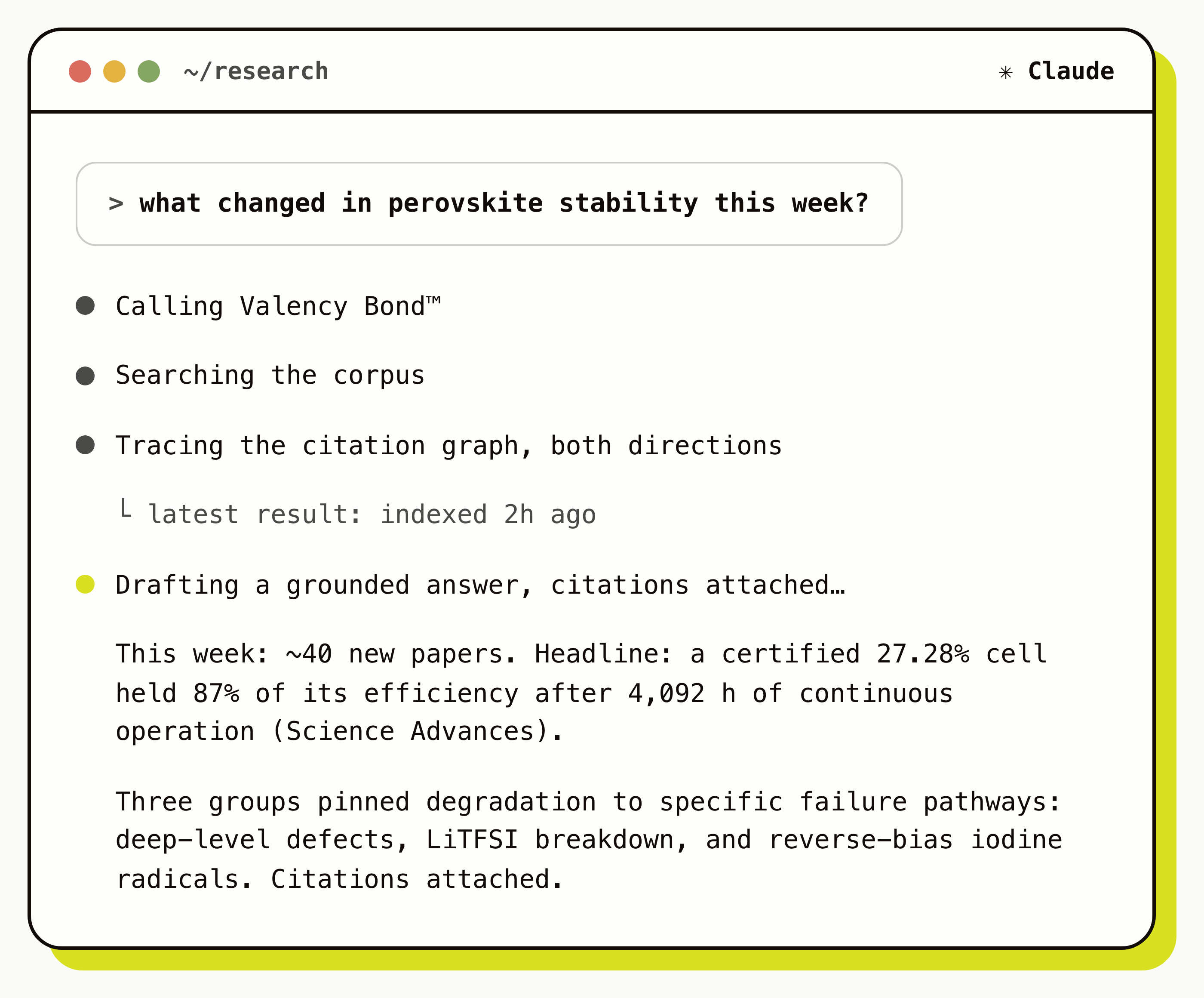
Bond is model-agnostic: a data layer, delivered over the Model Context Protocol that you can feed into any large language model. We provide off-the-shelf connectors for Claude, ChatGPT, Codex, Antigravity, Kiro, including open-weight models that you self-host.
Valency Bond integrates seamlessly with existing workflows and doesn’t require you to adopt a new tool. As scientists ourselves, we recognize how important it is to build your own setup: tools, harnesses, workflows, and collaboration practices. Bond works with the latest frontier models and with open-weight models you run locally. We’re continuing to invest in Bond, bringing it to more of the places you do your research—writing tools, notebooks, and co-scientist systems.
Bond is free for individual users
Bond is free for individual users at valency.io/bond, with paid plans for larger teams and organizations. You can sign up with a Google Workspace, GitHub, or Microsoft 365 account and get access to the full corpus and every tool instantly. For researchers who sign in with their academic email address or ORCID, we offer a higher rate limit to support day-to-day research tasks.
Bond can generate BibTeX files from your searches, and if you want to submit data quality feedback, you can do it directly from your session using /submit-feedback. If something isn’t right, our support team can investigate and follow up.
We are grateful to the many individual researchers who tested Bond during the private beta, alongside our colleagues at Lawrence Berkeley National Laboratory, CU Anschutz Medical Campus, Stanford, Harvard, Cambridge, and many other organizations. Their feedback, bug reports, and ideas helped us address complex challenges and deliver a high-quality product.
What’s next for Valency Bond
Over the coming months you’ll see more tools, surfaces, and literature sources entering the MCP at an even faster rate than before. If you would like to talk to us about adding custom data sources relevant to your field, more use cases, or newer endpoints, we are always open and listening.
Bond was built by researchers, for researchers. Have a research data source, use case, or workflow you’d like to see supported? We welcome independent comparisons and feedback on where Bond works well and where we can improve. Connect directly with our team: support@valency.io
Ready to try Bond? Start researching in minutes
For individual users, get Bond for free.
For teams, organizations, custom data sources, and higher-volume access, contact matt@valency.io.
Happy researching!